
Story - Quinlan - Rooted in sustainability
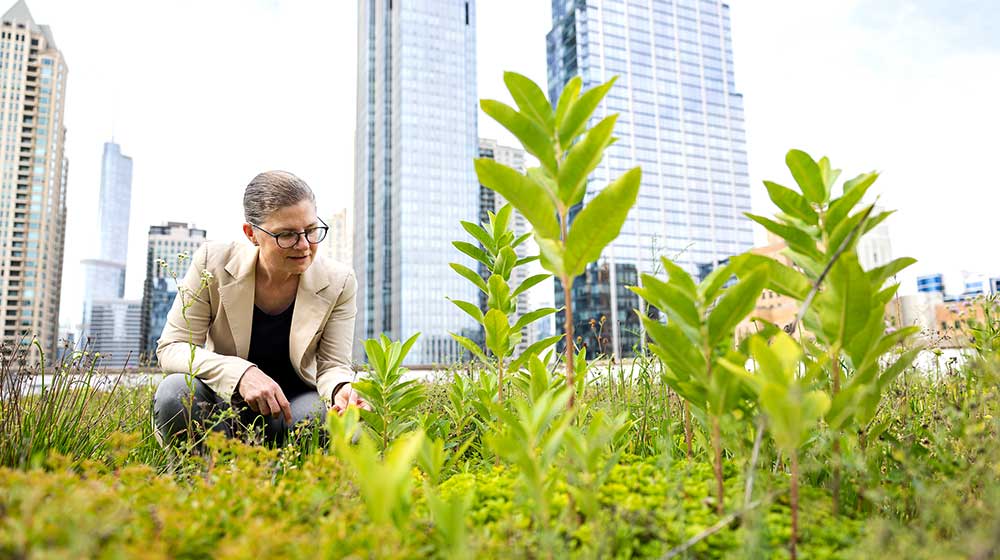
Portrait of Karen Weigert, director of the Baumhart Center, atop the Schreiber Center on Loyola's Water Tower Campus. Weigert advocates for planting native grasses for residential lawns and installing green roofs in urban areas. (Photo: Lukas Keapproth)
When it comes to sustainable business practices, Loyola leads the way
In Quinlan, a business education ties career growth and social impact
Loyola University Chicago leads with purpose and seeks to educate students to make an impact on their communities and the environment. In the Baumhart Center for Social Enterprise and Responsibility, students prepare to build and shape businesses with ethical, sustainable values.
Loyola University Chicago, a recognized leader in the areas of sustainability, social justice, and responsible governance, has a wealth of initiatives, programs, and academic offerings that help create a better environment and promote innovative solutions to social and economic inequalities. The threads of many of these initiatives are woven throughout the fabric of the university, reaching into communities near and far.
At her home on Chicago’s north side, Karen Weigert’s green roof sprouts native prairie plants: Little bluestem, purple coneflower, butterfly weed. It’s a lovely oasis, and it’s also environmentally friendly—cooling the surroundings, soaking up stormwater, and attracting birds, butterflies, and other pollinators.
Of course, Weigert doesn’t need to stay at home to enjoy the benefits of natural landscapes. As the director of the Baumhart Center for Social Enterprise and Responsibility at Loyola University Chicago’s Quinlan School of Business, she can gaze out the south-facing glass facade of the Schreiber Center at a green roof atop Maguire Hall. Comprising the largest green roof acreage of any Midwest campus, Loyola boasts 17 that span more than 55,000 square feet on the Lake Shore and Water Tower campuses.
“The fact that Loyola has been leader in environmental stewardship and is hard at work creating a sustainable campus and reducing its carbon footprint is absolutely the reason I joined,” said Weigert.

Loyola University Chicago
The pursuit of purpose
Loyola University Chicago has yielded research that not only informs, but has real impact.
Read more about Loyola's social impact
Quinlan School of Business
Discover Loyola’s holistic approach to AI with coursework
Executive Lecturer Steven Keith Platt spearheads new AI curriculum centered around a well-rounded technical and ethical education.
Read more about AI at Loyola
Parkinson School of Health Sciences and Public Health
Loyola research finds link between GLP-1s and addiction
Professor Fares Qeadan's study finds 50% reduction in alcohol use for those with alcohol-use disorders taking GLP-1 medications.
Read more about GLP-1 researchThat’s an especially strong endorsement coming from Weigert, a former Goldman Sachs investment banker who served as the first-ever chief sustainability officer for the City of Chicago, helped write and produce the acclaimed documentary film Carbon Nation, and is a regular sustainability contributor for WBEZ’s daily talk show, In the Loop.
And she is hardly the only one praising the University’s commitment to sustainability. Loyola recently ranked 12th in The Princeton Review’s “Guide to Green Colleges: 2025 Edition,” making it the highest-ranked Jesuit institution and the top school in Illinois on the list. And considering that the University achieved carbon neutrality in 2024, this accolade is well earned.
Among its academic programs, the Baumhart Center for Social Enterprise and Responsibility at Quinlan offers one of the most transformational MBAs in the nation. The Baumhart Scholars MBA is a highly selective, cohort-based degree program for working professionals who want to drive forward their careers and their social impact simultaneously. “There’s a focus on profit and purpose, and we weave into that environmental and social impact in a way that is very unique,” Weigert said. “It’s highly selective and has required classes that are the typical MBA curriculum at a high level, including marketing, accounting, and finance. But all of those classes are taught with examples of social and environmental impact.”
We're working to support thriving communities in an inclusive economy on a healthy planet. And we're looking at how we can create the biggest impact for the most people for the longest period of time. Karen Weigert, Director, Baumhart Center for Social Enterprise and Responsibility
In addition, the Quinlan School of Business began offering a Baumhart Certificate in Environmental, Social, and Governance in 2023. The ESG Certificate program is flexible and capitalizes on the deep scholarship and experience of faculty and mentors in the Baumhart Scholars MBA program, while tapping the specialized knowledge throughout the university. “It's the first-ever collaboration of a certificate launched across multiple Loyola schools. It's officially housed in Baumhart within Quinlan but launched in partnership with the School of Environmental Sustainability and the Parkinson School of Health Sciences and Public Health,” said Weigert. “What's so important about that is if we think about the themes inside environmental, social, and governance concerns, they cross sectors.”
The ESG Certificate is just one example in the tapestry of curricula and programs at Loyola that have been created to improve lives. “We're working to support thriving communities in an inclusive economy on a healthy planet. And we're looking at how we can create the biggest impact for the most people for the longest period of time,” Weigert said. “These are ways to accelerate careers and build practical pathways to create the future that we all want, need, and deserve. And it builds from the individual things that we can all do in our homes and in our days, into the organizations that we build and the cultures that we create.”